Category Archives: Random Ramblings

Anything that catches my fancy as a topic I want to cover. Truly random crap.

GPS users disengage brains?

I have insufficient proof to consider this an absolute truism, but I think that there is evidence to make one think that users of GPS systems operate them by turning off their brains.

A 20-year-old student’s car was wrecked by a train after she followed her sat nav system onto a railway track.

. . .

“I put my complete trust in the sat nav and it led me right into the path of a speeding train,” she said.

“The crossing wasn’t shown on the sat nav, there were no signs at all and it wasn’t lit up to warn of an oncoming train.

Unfortunately, if you read the full story, you’ll see that it is conceivable that this was more than just blind faith in the GPS. The rail crossing was unmarked, it was dark, and manual manipulation of the cross gates was required to cross. But that’s not all my evidence. You can see more examples if you keep reading.

Continue reading

Evil coming to DS, Wii, and PC

Beware! Unbeknownst to most of the world, evil has been declared a near-future release for the the Nintendo DS and Wii, as well as on the PC (but really, we’re pretty much used to evil on the PC, aren’t we?).

According to publisher THQ, there are a total of three new titles currently in development based on the popular doll line. The first two video games Bratz: 4 Real and Bratz Super Babyz will be both released on DS and Games for Windows platforms this Fall.

4 Real was actually based from the upcoming Bratz theatrical release. Furthermore, the other title will be known as Bratz: The Movie and will make an outing on Wii, PlayStation 2 (PS2), and even on GameBoy Advance (GBA).

Most disturbing of all is mention of the Bratz theatrical release. Soon, your eyes will be overwhelmed with the evil that is Bratz.

Technorati Tags: , , ,

House investigating credit report inaccuracy difficulties

Now it isn’t often that I’ll be in favor of the government encroaching more into the affairs of businesses (a trait that makes the liberals disown me, but not an important enough trait for the conservatives to embrace me), but I do think that news of House Financial Services Committee hearings in credit report inaccuracies is a good thing. The full text of the hearings is not available at the time of this writing, but you can view the archived video from the hearing while you wait for a transcript. (via Consumerist)

Technorati Tags: , ,

Finally, GIF is free

Old news, but I hadn’t paid attention and realized that, unemcumbered by patents finally, the GIF format is truly free.

I am sure a lot of you remember the great “GIF fiasco”: more than a decade ago, Unisys decided to make money out of the most used image file format on the Internet: the GIF format. To be more precise, Unisys announced that they would go after developers of programs able to load and save GIF files (never mind the fact that even back then there was plenty of free software which wouldn’t have been able to pay).

To make the short story shorter, the PNG file was invented as a reaction to Unisys’ move; although it was never wildly successful, PNG did manage to make Unisys’s threat very much irrelevant. Unisys took their time, but eventually realised that if they had seriously sued people over the GIF patent, the days of the GIF format would be over.

. . .

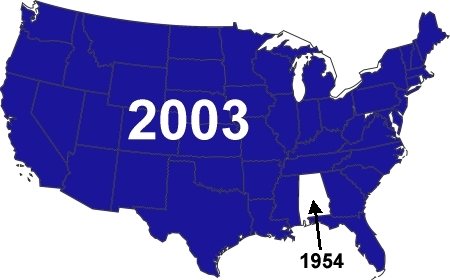
1. We were able to search the patent databases of the USA, Canada, Japan, and the European Union. The Unisys patent expired on 20 June 2003 in the USA, in Europe it expired on 18 June 2004, in Japan the patent expired on 20 June 2004 and in Canada it expired on 7 July 2004. The U.S. IBM patent expired 11 August 2006, The Software Freedom Law Center says that after 1 October 2006, there will be no significant patent claims interfering with employment of the GIF format.

So between Unisys giving up on suing (what with that probably killing the format, leaving Unisys in charge of absolutely nothing) and the expiration of the patents which caused the ruckus, we can finally use GIF without fear of problems from the patent police.

Technorati Tags: , ,

Protecting Bigfoot

Here at the Blahg, it’s all about protecting species and natural resources. So when there is news around the interpipes of others seeking to do the same, that is something worth pointing out for commendation. So it is with great pride that today’s conservation and protection shout-out goes to Canadian parliament member Mike Lake for his introducing a petition to protect Bigfoot under the Canadian equivalent of our endangered species act.

Lake presented to the House of Commons a petition that stated, “The debate over (Bigfoot’s) existence is moot in the circumstance of their tenuous hold on merely existing. Therefore, the petitioners request the House of Commons to establish immediate, comprehensive legislation to affect immediate protection of Bigfoot.”

The man behind the petition was a Bigfoot enthusiast named Todd Standing, who claims to have definitive proof of Bigfoot but is withholding it until protection for the alleged animals is in place. “When I get species protection for them nationwide, I will make my findings public and I will take this out of the realm of mythology. Bigfoot is real,” Standing said.

The petition soon became an embarrassment for Lake, who later issued a press release stating that the proposal had been tabled.

Ahhhh, tabled already. So Bigfoot might not yet have protection. That means if you get a good sighting of him/her/it, you should take the shot now. Sometime in the future, Bigfoot will be protected meat.

Technorati Tags: ,

A dating story

A bit of weak humor from a cow-orker:

A man is dining in a fancy restaurant and there is a gorgeous redhead sitting at the next table. He has been checking her out since he sat down, but lacks the nerve to talk with her.

Suddenly she sneezes, and her glass eye comes flying out of its socket towards the man.

He reflexively reaches out, grabs it out of the air, and hands it back.

Continue reading

The risk of information leakage and the Slingbox Pro

Security is hard. Sometimes, you secure the information well enough that it is infeasible to determine what the encrypted information is, and you feel like you’ve done well. Normally, that would be enough. However, sometimes you have some clever folks come along and look at the characteristics that aren’t subject to encryption to figure out what the secured data is. Basically, an attack on the secondary information in the stream. So what, exactly, does this mean? Well, in this particular instance, I found the security and privacy analysis on gadgets extremely interesting. These researchers were able to determine with extremely high accuracy what movies were being streamed from a Slingbox Pro based on the variation in amount of data sent. They couldn’t tell what the data was, but could still count the number of bits and compare that information to known characteristics of the unencrypted streams from movies to guess what was being passed.

The Slingbox Pro is not the only target of their investigations, but it is the most interesting to me. They also find privacy issues with the Nike+iPod Sport Kit and security issues with Microsoft’s Zune social relationships.

We analyze three new consumer electronic gadgets in order to gauge the privacy and security trends in mass-market UbiComp devices. Our study of the Slingbox Pro uncovers a new information leakage vector for encrypted streaming multimedia. By exploiting properties of variable bitrate encoding schemes, we show that a passive adversary can determine with high probability the movie that a user is watching via her Slingbox, even when the Slingbox uses encryption. We experimentally evaluated our method against a database of over 100 hours of network traces for 26 distinct movies.

Despite an opportunity to provide significantly more location privacy than existing devices, like RFIDs, we find that an attacker can trivially exploit the Nike+iPod Sport Kit’s design to track users; we demonstrate this with a GoogleMaps-based distributed surveillance system. We also uncover security issues with the way Microsoft Zunes manage their social relationships.

Continue reading

OpenOffice.org tips and tricks site

Here goes one of my infrequent discussions on using legally free software. I’m not fond of the escalating price of software, especially considering how often new features are unnecessary for anything but to drive the ongoing need for more powerful hardware. And while I do know all the means of acquiring software illegally, I do use legal copies of software. Whenever possible, I download and instally legally free software, whether public domain, open source, freeware, ad-supported (although rarely) or any other means of legitimately free distribution. I do pay and use some applications, such as Nero and X to DVD, if I can’t find a free alternative that I like, but luckily, there are few needs for commercial software in my daily computing time outside of my games.

One of the applications my wife uses frequently is Microsoft Office. I don’t want the bloat from that on my system, but occasionally she works on my computer and needs access to some type of Office product. I’ve worked around this by installing OpenOffice.org (often referred to as OO.o) and Abiword for her to use. Unfortunately, I’m not very strong with OO.o, and sometimes Abiword doesn’t have all the features she needs. So, what to do? Why, I think I’ll buy a book and also read the author’s blog to learn how to better use OO.o. That should be a nice distraction from my other current reading – Beginning GIMP.

You can buy the book from the author for $30 via paypal, or head to Amazon and get it for $59.99. I have no idea why the price difference, but I’ve ordered my copy from the author.

So to reiterate – if you are tired of the cost of commercial software, consider many of the excellent free alternatives (and feel free to contact me for help finding tools for your tasks – I love tracking down stuff online). If you are in the market for office productivity software, consider OpenOffice.org, and read this hints and tips site to learn it (and consider buying the book).

Technorati Tags: , ,

Is this sleazy, or am I imagining that?

I know there is great profit to be made from exploiting those with the least financial resources. I understand that financial transactions with this class of consumers can be risky. I understand that high-risk endeavors can lead to high reward results. None of that helps me overcome my initial reaction that this is a sleazy financial tactic that abuses lower-income families and individuals.

Walmarts Tries To Become Your Bank With The “Walmart MoneyCard”

. . .

Check our Walmart’s awesomely evil deal: Cashing your check costs $3.00, but if you put the money on a Walmart MoneyCard, they’ll waive the $4.64 “loading” fee. Neat! After that it’s only $4.94 a month to keep your money on the card.

Want to know how much is left? That’ll be $0.70 to check your balance .This card, in essence, takes people who don’t have access to the banking system in this country and makes Walmart their “bank.” Except it’s a “bank” where it costs $1.95 to get money from an ATM, but getting “cash back” from Walmart’s POS is free! If you deposit more then $1,000, Walmart will generously waive the monthly maintenance fee on the card. Want to speak to a teller? That’ll be $3.50. Your paper statement? $2.00. What a deal!

My wife decided we were to boycott Wal-Mart several years ago. This just feels like another reason to pass on passing my money to the corporation. My understanding is that Sam Walton never would have abused the country like this, but I could be way off base.

Technorati Tags: ,

Terrorism database

Right up front, I’ll point out that this could be very useful in political discussions about the current state of American. However, until I’ve had time to view more of the data and get an idea of what’s in there, I’ll avoid any actual discussion of political implications. That out of the way, now is a good time to read up on the global terrorism database put together with funding from the Department of Homeland Security.

The majority of terrorist attacks result in no fatalities, with just 1 percent of such attacks causing the deaths of 25 or more people.

And terror incidents began rising some in 1998, and that level remained relatively constant through 2004.

These and other myth-busting facts about global terrorism are now available on a new online database open to the public.

The database itself is accessible through a University of Maryland web site.

Continue reading