
Skype to charge in 2007

Word from TechCrunch is Skype will be charging for usage in 2007.

Beginning in 2007, SkypeOut calls will no longer be free within the US and Canada. The company announced on Wednesday that they would start to charge a yearly fee to call from Skype to any mobile or land-line phone. Calls from PC to PC will remain free.

Unlimited yearly calling will cost $29.95. If you purchase the plan before January 31, 2007, it will only cost $14.95. Without an unlimited plan, users can pay 2.1 cents per minute to calls within the U.S. and Canada, which is the same as the rate for international calls.

I don’t use Skype, but man I sure know a lot of folks that do. I believe even my wife uses it. And I have been thinking about getting a USB Skype phone just to make it easier to use if I decide to hop on the bandwagon.

[tags]Skype to charge in 2007[/tags]

Smartify yourself

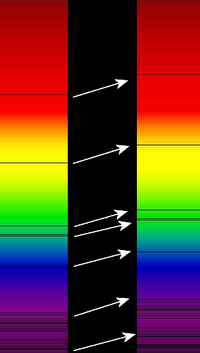
The virtual vault of knowledge that is Wikipedia has as today’s featured article the subject of Redshift. wikipedia-200px-Redshift.png

In physics and astronomy, redshift occurs when the visible light from an object is shifted towards the red end of the spectrum. More generally, redshift is defined as an increase in the wavelength of electromagnetic radiation received by a detector compared with the wavelength emitted by the source.

Continue reading “Smartify yourself”

2006 – The year in political gaffes

Covering a number of the bigger foul-ups by politicians, ABC news’ coverage of this years political blunders highlights thing such as the unravelling of a Presidential candidate to a former candidate’s poorly made joke to hunting with the VP. Here are just a few highlights.

  • Rebuilding a Metaphor

    New Orleans Democratic Mayor Ray Nagin, during a City Hall tribute to Martin Luther King Jr. last January, committed one of the year’s earliest flubs when he called on the African-American community to rebuild a “chocolate New Orleans” in the post-Katrina landscape.

    I can tell you that I was surprised when I heard this comment. New Orleans is far too hot and humid to make for a good chocolate manufacturing city. Not that I ever recall the city being involved in the production of chocolate before Katrina hit. And what else could he possibly mean by this?

Continue reading “2006 – The year in political gaffes”

Light exceeds speed of light

This is old news, but it was new news to me, which makes it news. That whole “If you didn’t know it, it’s news to you” bit applies, I suppose. Anyway – last year, some smarty-pants scientists showed some control over the speed of light in optical fiber. Slowing down light to 1/3 its natural speed was a noteworthy feat. But when the scientists were able to speed to light up to faster than the natural speed of light, well, that was phenomenal.

On the screen, a small pulse shifts back and forth – just a little bit. But this seemingly unremarkable phenomenon could have profound technological consequences. It represents the success of Luc ThÊvenaz and his fellow researchers in the Nanophotonics and Metrology laboratory at EPFL in controlling the speed of light in a simple optical fiber. They were able not only to slow light down by a factor of three from its well – established speed c of 300 million meters per second in a vacuum, but they’ve also accomplished the considerable feat of speeding it up – making light go faster than the speed of light.

This is not the first time that scientists have tweaked the speed of a light signal. Even light passing through a window or water is slowed down a fraction as it travels through the medium. In fact, in the right conditions, scientists have been able to slow light down to the speed of a bicycle, or even stop it altogether. In 2003, a group from the University of Rochester made an important advance by slowing down a light signal in a room-temperature solid. But all these methods depend on special media such as cold gases or crystalline solids, and they only work at certain well-defined wavelengths. With the publication of their new method, the EPFL team, made up of Luc ThÊvenaz, Miguel GonzalÊz Herraez and Kwang-Yong Song, has raised the bar higher still. Their all-optical technique to slow light works in off-the-shelf optical fibers, without requiring costly experimental set-ups or special media. They can easily tune the speed of the light signal, thus achieving a wide range of delays.

The article goes on to explain how this can have an important impact on light-processing systems for network switches and computers. In fact, it is important enough that the US Defense Advanced Research Projects Agency (DARPA) is investing heavily into continuing this research. Cool.

[tags]Light goes faster than the speed of light, Controlling the speed of light in optical fiber[/tags]

I never knew it could mean so much

This almost falls into my “Useless Knowledge” category, but there is enough good information for me to spare it that designation. While looking up the proper spelling and meaning of “gaffe” I found this entry on Wikipedia on the meaning of “error” instead. Learn the difference between an error in biology, baseball, computer science, statistics and so on. A quick and easy read with some interesting trivial knowledge attached.

[tags]Error, The many meanings of error[/tags]

Testing in-game ads via eye tracking

This has to be one of the neatest uses of eye tracking I’ve seen. With the recent increase in real-world advertising in online games, and the talk of advertisers and game distributors working on bringing in more, it seems at least one company has decided to check on the effectiveness of this move. And the results don’t look promising for advertisers or distributors banking on this.

Continue reading “Testing in-game ads via eye tracking”

Snow Crystals

I snowflake-AmSciCover.jpgfinally received my first issue of my American Scientist magazine subscription yesterday, and consumed a chunk of it in my spare time last night. The cover has this awesome snowflake image, from a microphotography snap of a complex snowflake. Here’s a cropped shot of it, taken from the web site by the author of the snowflakes article in the magazine(apologies for that horrid grammar). I hope I won’t get in trouble from the author from snagging this photo.

In the article, Kenneth G Libbrecht discusses the creation of snowflakes, the different kinds of snowflakes, some history of snowflake studies and snowflake photography, “designer” snowflakes, and much more. Reading this is akin to reading a Scientific American article, although I find American Scientist articles to be much more readable. The article is available online, but you have to subscribe to the magazine or be a member of Sigma Xi to access it. I recommend just buying the magazine at the newstand.


It is in fact true that no two snowflakes are alike. These single crystals of ice are so affected by subtle changes in temperature, water saturation, mineral content and wind speed that it’s nigh impossible that two would experience the exact same conditions during their growth. Indeed, just a few degrees’ temperature shift can alter a snowflake from the flowery form that we typically think of into a needle or a cluster of bullet-shaped columns. Libbrecht details many of these forms and how they arise, but also how much remains unknown about the elusive shapes. One of his newest theories relates to the fact that the very thin edge of a snowflake becomes highly unstable, leading to unexpected growth. Libbrecht’s work can be applied to the growth of crystals used for semiconductors, as well as other nanoscale processes of material formation.

All that said, I really just want to direct folks to the author’s web site. There are some amazing images there, and a lot of information on snowflakes. It’s a much more interesting topic that I would have guessed.

[tags]Snowflakes, The formation and study of snowflakes, Photographing snowflakes[/tags]
Gaming industry’s biggest blunders – 2006 edition

I love pointing out the failures of others.  So when I see a site like Next Generation cover the gaming industry’s top 10 blunders of 2006, I have to pass that on.

5. Gizmondo Crashes, Exec Follows Suit

In January the underdog handheld company Gizmondo imploded and threw itself at the mercy of its creditors. At the time no one suspected that the most fascinating part of the Gizmondo story was still to come. In February Stefan Eriksson, former executive at Gizmondo, taught his Ferrari Enzo how to fly on a stretch of the Pacific Coast Highway, slicing the million-dollar car neatly in half, and creating the world’s first performance art re-enactment of the rise and fall of a videogame company.

Of course, it wasn’t really Eriksson’s fault. As he told it, a mysterious German named Dietrich was driving the doomed sportscar when it crashed. Eriksson was just innocently sitting in the passenger seat of a flying Ferrari when it collided with a pole and blood flew off his lip and onto the driver-side airbag. Happens all the time, really.

That’s my favorite.  In fact, the others aren’t even that interesting.  But hey, faults is faults, and I’m all about them’s getting the faultification highlightingism they deservify.

[tags]Gaming Industry’s biggest blunders 2006[/tags]

On Parthenogenesis

Yeah, I’d never heard of it either, but a cow-orker was talking to me tonight about the Komodo dragons which just reproduced asexually, and that sounded like something I needed to read up on. I knew about gender-changing frogs, but hadn’t heard about asexually reproducing reptiles. Turns out it is known among smaller reptiles and mice, but that the Komodo dragon was capable of Parthenogenesis was unknown before this event.

The world’s largest lizard has astonished biologists by being able to produce offspring by an “immaculate” conception without the help of a male.

Two captive female Komodo dragons have had virgin births by a process called parthenogenesis, when an unfertilised egg develops into a normal embryo without being fertilised by a sperm.

I hope this phenomenon doesn’t catch on. I know quite a few females who want children without a male being involved. I hate to think of all the men who will be joining me in my life unchosen chastity when female humans figure out how to do this on their own. Sounds a bit like a Star Trek episode, doesn’t it?

[tags]Asexual reproduction in the reptile world, Men to become obsolete?[/tags]

The robots – now they get you drunk

Closer, closer, comes the robot uprising. I’m preparing every day. Are you? The latest news that indicates the robots are working to bring down all humanity is this tasty brief on Robomoji (the robotic bartender). That’s right – the robots will get us drunk first, which should make the human-takedown ploy easier to pull off. In an attempt to protect all humanity, I will abstain from drinking any non-human poured liquor. (via TechEBlog)

Robots have way too many roles these days, ranging from security sentries to cellphone salesbots. Too mundane, you say? What about something that will surely please everyone at your party: a bot that can play bartender?

[tags]Robotic bartender, The nearing robot uprising[/tags]

First X flight (for various values of X)

Today being the 103rd anniversary of the Wright Brother’s first flight, I thought it might be nice to quickly cover some other first flights that preceeded the Wrights’ flight. Most of the following information is ripped and modified from the excellent gathering of information hosted at the Dalle Molle Institure for Artificial Intelligence.

Continue reading “First X flight (for various values of X)”