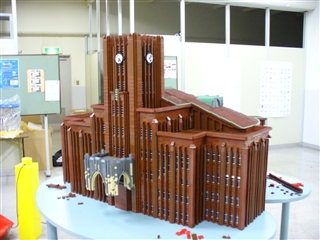
The site is in Japanese, but LEGO pictures are universal, aren’t they? Check out the University of Tokyo’s LEGO club replica of the university clock tower.

(via Neatorama)
[tags]University of Tokyo clock tower in LEGOs[/tags]
The most valuable supply of worthlessness on the web
The site is in Japanese, but LEGO pictures are universal, aren’t they? Check out the University of Tokyo’s LEGO club replica of the university clock tower.
(via Neatorama)
[tags]University of Tokyo clock tower in LEGOs[/tags]
Catching up on my Tingilinde reading this evening, I found a recent article there linking over to PLoS ONE. I had never heard of this site, but the article sounded interesting so I followed the link. That article, Ionizing Radiation Changes the Electronic Properties of Melanin and Enhances the Growth of Melanized Fungi, is way beyond my means of comprehension. However, the site byline, “A new way of communicating peer-reviewed science and medicine”, intrigued me. I spent a little time searching around the site to see just what PLoS ONE is. If you look at the site, you can find that it is an open access science journal, and it offers peer reviewed scientific studies for your online consumption.
PLoS ONE (eISSN-1932-6203) is an international, peer-reviewed, open-access, online publication. PLoS ONE welcomes reports on primary research from any scientific discipline. PLoS ONE is published by the Public Library of Science (PLoS), a nonprofit organization. PLoS ONE’s start-up phase is supported by a grant from the Open Society Institute.
. . .
All works published in PLoS journals are open access, licensed under the Creative Commons Attribution License. Everything is immediately available online without cost to anyone, anywhere-to read, download, redistribute, include in databases, and otherwise use-subject only to the condition that the original authorship is properly attributed. Copyright is retained by the author.
From what little I’ve poked around, it appears that the site is offering credible scientific information via what I call the Cory Doctorow method of riches through free content. Yes, it is a method that I realize others have also done. It just works in my mind to tie the practice to someone whose work I’ve consumed heavily.
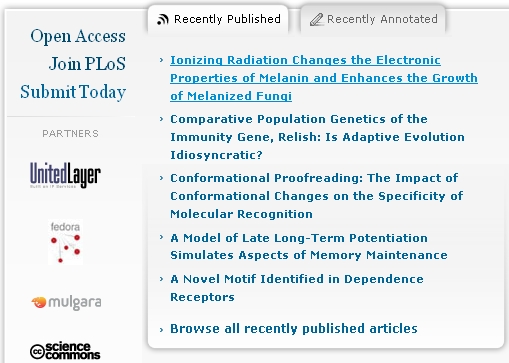
If you are at all interested in what is going on in the scientific world, PLoS ONE is a good site to add to your sites-worth-visiting list. Just expect to find lots of works that are over your head (sample below). OF course, many of you may be much brighter than I am, so you might not find that to be the case, but I certainly couldn’t grok much of what I saw there. It was, regardless, quite fascinating.
Oh, and that PLoS thing? Well, that stands for the Public Library of Science. Just in case you wondered (I did, and found it while poking around the site). And if you are looking for more science sites worth visiting, just let me know and I’ll add some of the other places I’ve found to be worth the time investment.
[tags]Public Library of Science online journal, Science sites worth visiting[/tags]